News
Inside the 2026 harvest at La Vierge Farm on the Hemel-en-Aarde Ridge
This season has been shaped by dry conditions, late rainfall and shifting picking windows. With vineyards farmed without irrigation, each step reflects what the season has delivered.
At La Vierge Farm, harvest is never simply a date on the calendar. It’s the moment when a year’s worth of vineyard decisions begins to reveal itself.
Harvest on the Ridge
At La Vierge Farm, harvest is never simply a date on the calendar. It’s the moment when a year’s worth of vineyard decisions begins to reveal itself.
The 2026 harvest began slightly earlier than usual following a dry growing season on the Hemel-en-Aarde Ridge. Chardonnay led the way into the cellar on 13 February.
On the Hemel-en-Aarde Ridge, conditions favour a slower, more measured ripening of Chardonnay and Pinot Noir, shaped by the influence of the nearby Atlantic, altitude and ancient soils.
At La Vierge, these conditions play out in specific ways. Clay-rich Bokkeveld shale helps retain moisture through dry periods, and because the vineyards are dryland farmed, the vines rely on that stored water rather than irrigation. The farm’s natural amphitheatre exposes each vineyard block to its own balance of sunlight, wind and temperature. At harvest, these differences influence when each block is picked, how evenly the fruit ripens, and the balance it carries into the cellar.
The season Unfolds
The 2025–2026 growing season progressed steadily across the Ridge. Winter rainfall replenished soil moisture, while the Atlantic influence continued to moderate temperatures through the summer months.
The season was largely warm and dry, with a high volume of fruit on the vines. As harvest began, rain set in and continued through much of the harvest period, requiring careful timing and a more considered approach to picking.
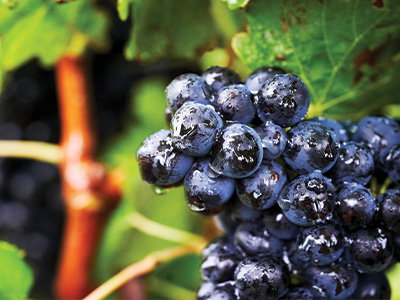
For much of the season, the fruit developed evenly on the vines, with healthy bunches hanging as harvest began.
Our winemaker Christo Kotze says yields were higher, with larger bunches across the vineyards. Conditions remained favourable through the early part of the season, with vineyard decisions becoming more deliberate following the onset of rain.
A Narrow Window
In early March, a brief but record-breaking heatwave moved across the region, adding urgency to the final stages of harvest, with teams working closely to keep pace with changing conditions.
The heat shortened picking windows initially, bringing harvest forward, while the rainfall that followed slowed sugar accumulation in certain varieties and extended the time needed before picking.
From Picking to Processing
La Vierge vineyards are dryland farmed, relying on natural soil moisture rather than irrigation. Each vintage is shaped by the conditions of the season, and the team responds to what the vineyard delivers rather than adjusting the outcome. “This harvest forced us to adapt in many ways and to focus on each parcel as an individual, changing the approach to what the vineyard gave us,” Christo explains.
In the Cellar
The La Vierge approach combines restraint with thoughtful use of different vessels and techniques to handle each parcel individually. Fruit is cooled before processing, white grapes are separated from their skins early, red grapes remain on skins before fermentation, and each vineyard block is vinified separately to preserve its individual character.
Fruit and Variation
Fruit concentration has been strong this season, although Christo points out that acidity levels have dropped in some parcels, which is slightly atypical for the region.
Early Chardonnay and Pinot Noir blocks have shown strong concentration and volume, while later parcels have required a more measured approach following the rains.
Maturation and Structure
Maturation continues in a range of vessels that allow our cellar team to shape the wine with care. Alongside stainless-steel fermenters and tanks, La Vierge uses amphorae, French oak barriques and larger-format oak vessels, each contributing differently to texture and structure while allowing the fruit and site to remain clearly expressed.
This includes foudre (2500L oak), concrete egg, amphora, 500L puncheons, 228L barriques and stainless-steel tanks.
Precision in the Cellar
This year, we have introduced a new German wine press, a practical investment that supports our approach of combining traditional methods with carefully chosen modern equipment. It allows for more efficient processing and improved press juice quality, contributing to greater precision in the cellar.
A Consistent Approach
This focus on precision in the cellar is closely tied to Christo’s way of working. His experience includes time in the Hunter Valley and Tasmania in Australia, as well as Napa Valley in the United States, working with Chardonnay, Pinot Noir and Cabernet Sauvignon.
Since joining La Vierge in 2017, Christo has helped shape wines that aim for purity, precision and a clear sense of place. His winemaking philosophy is simple in principle, though never simplistic in execution: focus on detail, avoid unnecessary intervention and allow the site to speak.
A Harvest Still Taking Shape
The 2026 harvest is still unfolding in the cellar, so its full character will only become clear with time. As Christo puts it, “It ain’t over until it’s over.”
At La Vierge, harvest brings together a year of vineyard decisions shaped by the Ridge and carried through carefully in the cellar. There is a quiet confidence in how the fruit has come through the season, with the wines now beginning to take shape in the cellar.
For a closer look at the thinking behind the vineyards, explore what Trust the Site means at La Vierge, or discover more about cool-climate Chardonnay and Pinot Noir from the Hemel-en-Aarde Ridge. The La Vierge Tasting Room and Restaurant in the Hemel-en-Aarde Valley offers a chance to experience these wines at the table, just 8km from the farm.